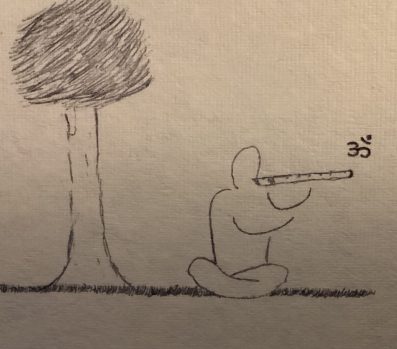
The notion that God or the universe is “musical” speaks to an ancient intuition: that existence is governed by patterns, vibration, and harmonious relationships—much like music itself.
In the Western esoteric tradition, this principle is reflected in the concept of the “music of the spheres,” articulated by Pythagoras and later echoed by Plato and early Christian mystics. They envisioned the cosmos as a vast, harmonious system wherein each planet and star emits a unique tone, creating a divine symphony. Here, music becomes a metaphor for the ordered, mathematical relationships underlying the manifest world. This idea permeates the Kabbalah as well, where the creative utterance (“Let there be light”) is not just speech, but vibration—an act of resonance that brings forth being from non-being.
Hindu philosophy, especially in the concept of Nada Brahma (“the world is sound” or “God is sound”), presents the universe as fundamentally vibrational. The primordial sound Om is said to be the source from which all creation unfolds, and the universe itself is continuously being woven through subtle sound—again, a musical process. This tradition suggests that by attuning one’s inner ear to these vibrations, a person may come closer to union with the divine.
From a psychological perspective, Jung might have argued that the musical metaphor represents the psyche’s drive for inner harmony—a dynamic balancing of opposites, like the interplay of consonance and dissonance in music. Music captures the way human beings experience meaning: not as static facts, but as dynamic, evolving patterns that can provoke awe, sorrow, joy, or even transcendence.
Modern physics, too, has explored this intuition. String theory, for example, posits that the fundamental constituents of reality are not particles, but vibrating strings whose different modes correspond to different particles—suggesting that, at its most basic level, the universe may literally be a kind of cosmic music.
Stay Attuned
 Music of the Spheres