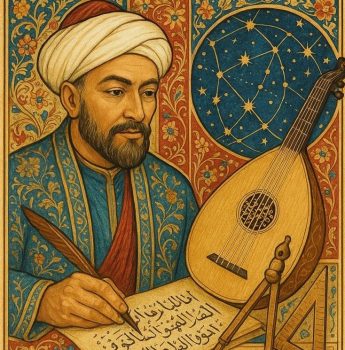
Hazrat Inayat Khan, a foundational figure in the transmission of Sufism to the West during the early twentieth century, expounded a philosophy in which music holds a central place not just as art, but as a spiritual practice and a metaphysical principle. For Khan, music is far more than organized sound; it is a universal language and a means for developing spiritual consciousness.
Khan taught that the entire universe is ultimately composed of vibration, and music is the most accessible and refined expression of this primordial reality. He saw music as the bridge between the finite and the infinite, capable of tuning the soul to higher states of awareness. The mysticism of music, in his understanding, involves perceiving the underlying unity and harmony that music both reflects and awakens within the individual. When attuned to music with sensitivity and presence, the listener is able to access subtle states of insight, peace, and connection with the divine.
For Khan, all religions and mystical traditions can be seen as expressions of the same music—the music of divine harmony manifested in different cultural forms. Musical practice becomes a vehicle for self-transcendence, enabling the seeker to experience directly the spiritual truth that lies beyond conceptual knowledge. Thus, music is not merely an ornament of spiritual life, but a profound practice—one that refines the heart, harmonizes the mind, and prepares the soul for union with the source of all being.
He was born in Baroda, India, (July 5 1882) into a family with a strong musical and spiritual heritage. From an early age, he studied classical Indian music and became an acclaimed musician, specializing in the vina, a traditional string instrument.
Khan was formally initiated into the Chishti Sufi Order, one of the major mystical schools of Islam, which emphasizes love, tolerance, and openness. He would later receive initiations in the Qadiri, Suhrawardi, and Naqshbandi Sufi orders as well, integrating these lineages into his teaching.
In 1910, he left India at the instruction of his Sufi teacher, carrying with him the mission to spread the message of spiritual unity to the West. He first traveled to the United States, and then to Europe, where he began teaching, performing music, and attracting students from many backgrounds.
His approach to Sufism was universalist, focusing on the essence of mystical experience rather than the dogmas of any single religion. He established the Sufi Order in the West—now known as the Inayatiyya—which continues to transmit his teachings worldwide.
Among his key contributions was the integration of music and mysticism. He articulated a detailed philosophy about the spiritual power of music, seeing sound and vibration as fundamental to all existence.
He wrote extensively, leaving behind a substantial body of lectures, poems, and books. Works like “The Mysticism of Sound and Music” remain central texts for those interested in the spiritual dimensions of music.
Hazrat Inayat Khan died in Delhi in 1927, but his legacy endures through the global Sufi movement he founded and the continuing influence of his writings on both Sufi and non-Sufi spiritual circles. His teachings remain vital for anyone seeking a synthesis of inner awakening, art, and universal spiritual values.
Stay Attuned
 Music of the Spheres