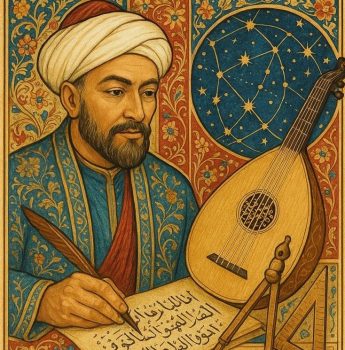
The “House of Song,” known in the Avestan language as Garōdmān or Garodemana, is one of the central spiritual concepts in Zoroastrianism (the world’s first known monotheistic religion). Often translated as the “House of Hymns,” “House of Praise,” or “House of Song,” it represents the highest spiritual realm and the dwelling place of Ahura Mazda, the supreme god of Zoroastrianism. More than simply a version of heaven, the House of Song symbolizes a state of perfect harmony with truth, wisdom, divine order, and spiritual illumination. In Zoroastrian thought, the universe is governed by Asha, the cosmic principle of truth, order, and righteousness, which stands in opposition to Druj, the force of falsehood, chaos, and corruption. Human beings participate in this cosmic struggle through their thoughts, words, and actions, summarized in the famous Zoroastrian ethical teaching: “Good Thoughts, Good Words, Good Deeds.” The House of Song is the ultimate destination for souls who align themselves with Asha during their earthly lives.
According to Zoroastrian teachings, after death the soul remains near the body for three days before beginning its journey into the spiritual world. On the fourth day, it arrives at the Chinvat Bridge, often called the Bridge of Judgment. There, the soul is judged according to the moral and spiritual quality of its life. For the righteous, the bridge becomes broad and easy to cross, while for those dominated by falsehood and selfishness it becomes dangerously narrow. Souls that successfully cross the bridge enter the House of Song, while those consumed by deception and evil fall into the “House of Lies,” a realm associated with spiritual darkness and separation from divine truth. Yet even here, Zoroastrianism differs from many later religious traditions, because its ultimate vision is not one of eternal damnation but eventual cosmic restoration and purification.
The House of Song itself is described as a radiant and luminous realm filled with peace, joy, and spiritual perfection. The righteous dwell there in the presence of Ahura Mazda alongside divine beings known as the Amesha Spentas, the “Holy Immortals,” who embody divine qualities such as wisdom, truth, devotion, wholeness, and immortality. However, the House of Song is not merely a paradise of comfort or reward. It is fundamentally a state of spiritual harmony in which the soul participates fully in the truth and order of creation. The “song” in its name is deeply symbolic. In Zoroastrianism, sacred hymns and spoken prayers possess immense spiritual power, and the universe itself is understood as ordered through divine truth and sacred utterance. The House of Song therefore represents a reality where existence itself resonates in harmony with Asha. The soul enters into a condition of divine praise, cosmic order, and spiritual resonance, almost as though it becomes attuned to the music of truth itself.
This idea gives the House of Song a mystical and philosophical depth that has fascinated scholars and spiritual thinkers for centuries. The concept resembles other traditions that associate reality with vibration, harmony, or sacred sound, such as the “music of the spheres” in ancient Greek philosophy or the Hindu concept of Nada Brahman, the idea that the universe is fundamentally sound or vibration. In the Zoroastrian context, the House of Song can be understood not only as a literal heavenly realm but also as a state of awakened consciousness and perfect alignment with divine reality. Light and fire, both sacred symbols in Zoroastrianism, are closely associated with this realm because they represent truth, purity, illumination, and spiritual awareness.
The concept is also tied to the Zoroastrian vision of the future known as the Frashokereti, the final restoration or renewal of creation. Unlike systems in which evil remains eternal, Zoroastrianism teaches that falsehood and corruption will ultimately be defeated, creation will be purified, and the cosmos restored to harmony. In this sense, the House of Song is not merely the destination of individual souls but the ultimate goal of existence itself: the reunification of creation with divine truth and order. It stands as one of humanity’s oldest and most profound spiritual visions of salvation, not simply as reward or escape, but as becoming fully aligned with wisdom, harmony, and the sacred music of reality.
Stay Attuned
 Music of the Spheres