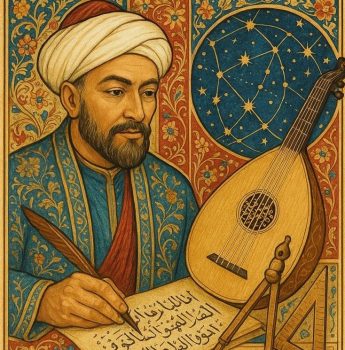
Maqams are the traditional melodic frameworks of Arabic, Turkish, Persian, and related musical traditions. While they are often compared to scales in Western music, a maqam is much more than a sequence of notes. Each maqam contains characteristic melodic patterns, emphasized tones, rules of movement, and a distinctive emotional or psychological atmosphere. Musicians learn not only which notes belong to a maqam but also how to unfold its unique character through improvisation and composition. Many maqams employ microtonal intervals—pitches that fall between the notes of a piano—which contribute to the subtle expressiveness and emotional depth for which these musical traditions are known.
The connection between maqam and mysticism is particularly strong within various Sufi traditions of the Islamic world. Mystics often regarded music as a means of awakening the heart and remembering humanity’s spiritual origin. In the practice known as Sama, music was listened to not merely for pleasure but as a form of contemplation capable of drawing the listener closer to divine reality. Different maqams were sometimes associated with different spiritual states, such as longing, devotion, humility, repentance, or inner balance. Rather than being viewed as entertainment alone, music became a vehicle for spiritual transformation and self-knowledge.
The instrument most closely associated with this mystical tradition is the Ney, whose breathy, plaintive sound became a symbol of the soul’s longing for reunion with the Divine. This symbolism is beautifully expressed in the writings of Jalal al-Din Rumi, who compared the human soul to a reed cut from its reed bed, forever yearning to return to its source. In this context, maqam music provides a sonic language through which feelings of separation, love, remembrance, and transcendence can be explored. A performer may move through several maqams during an improvisation, creating a musical journey that mirrors the soul’s passage through different stages of spiritual awakening.
Historically, some philosophers and music theorists, such as Al-Farabi, believed that music reflected deeper cosmic and mathematical principles woven into the structure of the universe. This idea parallels other mystical traditions that view sound as a bridge between the visible and invisible worlds. In this sense, maqam music can be understood as more than an artistic practice; it is a contemplative art that seeks to reveal hidden dimensions of human experience. For many mystics, the purpose of maqam was not simply to create beautiful melodies but to use sound as a means of cultivating awareness, spiritual longing, and a deeper connection with the sacred.
In the Indian classical tradition, a raga is much more than a scale or a collection of notes. A raga is traditionally understood as a living melodic personality that evokes a particular emotional, psychological, and spiritual state. The Sanskrit word rāga comes from a root meaning “to color” or “to dye,” implying that a raga colors the mind and consciousness with a specific mood (rasa).
In many streams of Indian spirituality, especially within Hindu, yogic, and devotional traditions, ragas are viewed as pathways for transforming awareness. Each raga is associated with particular emotions, times of day, seasons, and sometimes even deities. The idea is that nature, the human psyche, and sound are interconnected. Performing or listening to the appropriate raga at the proper time helps align the individual with cosmic rhythms. Dawn ragas, for example, often evoke awakening, purity, and contemplation, while evening ragas may encourage surrender, longing, or devotion.
The spiritual foundation behind ragas is closely related to the concept of Nāda Brahma (“the universe is sound”). According to this view, creation itself arises from primordial vibration. Sound is not merely an artistic phenomenon but a manifestation of divine reality. A raga becomes a vehicle through which a musician and listener can move from ordinary consciousness toward a deeper experience of the sacred. Improvisation within a raga is therefore not merely creative expression but can become a form of meditation, prayer, or communion with the divine.
In the Bhakti traditions, ragas are often used to cultivate love and devotion toward God. Saints such as Mirabai and Tulsidas employed musical modes to express spiritual longing and ecstatic devotion. In these traditions, a raga can awaken feelings of yearning (viraha), love (prema), peace (shanti), or divine bliss (ananda), helping the devotee draw closer to the sacred.
From a yogic perspective, certain teachers have also associated ragas with subtle energies and the chakras, although these correspondences are generally later interpretations rather than part of classical raga theory itself. The underlying principle remains that sound has the power to influence consciousness, harmonize the mind, and facilitate inner awakening.
For someone interested in mysticism, the raga can be understood as a sonic “maqam” of the soul, a sacred landscape through which consciousness travels. Just as Sufi maqam describe stations on the spiritual path, a raga may be experienced as a particular spiritual atmosphere that invites the listener into a unique mode of being. The goal is not merely aesthetic enjoyment but a refinement of perception, leading toward stillness, insight, devotion, and ultimately a deeper awareness of the unity underlying all existence.
Anhad Nada (also called Anahata Nada) means the “unstruck sound”, a sound that is not produced by two objects striking together. It is considered by most Indian traditions to be an inner, eternal vibration that exists prior to ordinary physical sound. Mystics describe it as a subtle current of consciousness that can be perceived during deep meditation. Rather than being heard through the ears, it is said to be experienced inwardly through heightened awareness.
The relationship between Anhad Nada and Indian ragas is both philosophical and spiritual. A raga is not merely a scale or melodic pattern; traditionally it is viewed as a living sonic form capable of evoking specific moods (rasa), states of consciousness, and even spiritual realization. Many Indian musicians and mystics have regarded ragas as a bridge between audible sound (ahata nada, struck sound) and the deeper reality of Anhad Nada. In this view, the disciplined practice of a raga refines the listener’s and performer’s awareness, gradually leading from external music toward the perception of the inner cosmic music.
Classical Indian music is rooted in the broader concept of Nada Brahma, the idea that the universe itself is fundamentally vibration or sound. Within this framework, ragas become vehicles for tuning consciousness to subtler dimensions of being. Certain ragas, especially those associated with devotion, contemplation, or specific times of day, are traditionally believed to quiet the mind and open the practitioner to deeper spiritual perception. While a raga itself is not Anhad Nada, it can be understood as a symbolic reflection or manifestation of the same cosmic order from which the unstruck sound arises.
Many saints and mystics drew this connection. For example, Kabir frequently spoke of the “unstruck melody” (Anahad Shabd) heard within the heart. Guru Nanak and later Sikh Gurus also described the Anhad Shabad as a divine inner music perceived through spiritual practice. In these traditions, external sacred music, singing, and ragas are valuable because they help orient the mind toward that inner sound current. From a mystical perspective, the finest performance of a raga is not simply entertainment or artistic expression, it is an invitation to remember the deeper music that, according to these traditions, is always resonating within consciousness itself.
Philosophically speaking, a psalm is the voice of the human soul addressing the divine. It is a form of sacred poetry or song that arises from lived experience and is directed toward God, ultimate reality, or the sacred mystery at the heart of existence. A psalm can express joy, gratitude, awe, sorrow, repentance, doubt, longing, or trust. What distinguishes it is its personal and relational character: it is the soul speaking directly to the divine presence. In this sense, a psalm is a dialogue between the finite and the infinite, an attempt to give voice to the deepest movements of the human heart in the presence of what transcends it.
A hymn, by contrast, is primarily a song of praise and contemplation that celebrates the nature, beauty, power, or goodness of the divine. Rather than focusing on the individual’s struggles or experiences, a hymn turns attention toward what is considered worthy of reverence. It proclaims sacred truths, honors divine attributes, and seeks to elevate the mind and spirit toward a higher reality. While a psalm often speaks to God from the perspective of human experience, a hymn often speaks about God, creation, or the sacred order of the cosmos. It is less a conversation and more an act of admiration, wonder, and praise.
Viewed together, psalms and hymns represent two complementary dimensions of spiritual expression. The psalm begins with the human condition and reaches toward the divine; the hymn begins with the divine and invites human beings to participate in its beauty and harmony. The psalm is the soul’s response to life in all its complexity, while the hymn is the soul’s recognition of a transcendent reality worthy of praise. In a broader mystical sense, the psalm can be understood as the unique voice of an individual soul within the universe, whereas the hymn is a celebration of the greater harmony of which that soul is a part. The psalm is the personal note; the hymn is the song of the whole.
A kirtan is a form of sacred musical devotion in the traditions of Hinduism, especially within the Bhakti (devotional) movements. Philosophically, kirtan is more than a song or performance; it is a spiritual practice in which music, rhythm, and sacred words are used to cultivate direct participation in the divine presence. Typically performed in a call-and-response format, kirtan involves the communal chanting of the names, qualities, or stories of God. The goal is not artistic perfection or entertainment but the awakening of devotion, love, remembrance, and spiritual awareness.
Unlike a psalm, which is often a personal prayer addressed to God, or a hymn, which primarily praises the divine, kirtan emphasizes active engagement and communion. Through the repetition of sacred names and mantras, participants seek to transcend ordinary mental activity and enter a state of focused devotion. In the Bhakti tradition, the divine name is not considered merely a symbol of God but a living manifestation of the divine reality itself. Thus, chanting becomes a way of encountering and participating in that reality rather than simply speaking about it.
From a mystical perspective, kirtan is often understood as a form of Nada Yoga, the yoga of sacred sound. The vibrations of the chant are believed to harmonize the mind, emotions, and spirit, gradually drawing the practitioner toward a deeper experience of unity, love, and transcendence. The individual voice joins with the voices of others, creating a shared field of devotion in which personal concerns temporarily dissolve into a larger spiritual consciousness. In this sense, kirtan is not merely music about the divine, it is music as a vehicle for divine communion.
If a psalm is the soul speaking to God and a hymn is the soul praising God, then a kirtan is the soul seeking to merge with God through the transformative power of sacred sound. It is a musical path of remembrance, devotion, and participation in what many practitioners regard as the eternal music of the universe.
Stay Attuned

 Music of the Spheres