To “tune oneself” is an evocative phrase that draws upon the metaphor of a musical instrument. In spiritual and esoteric traditions, it refers to the intentional act of aligning your inner faculties—your thoughts, emotions, and subtle energies—so that they resonate coherently, much like an instrument tuned to proper pitch. This process is not simply a matter of calming down or achieving momentary peace; it involves an ongoing, conscious refinement of your perception, motivations, and core attitudes.
The wisdom of many mystical paths, such as Sufism, Vedanta, and Western Hermeticism, emphasizes the importance of self-attunement as a preparatory step for deeper spiritual work. In practice, this may include meditation, breath control, mantra repetition, or acts of self-reflection. The purpose is to detect disharmonies within your mental and emotional patterns: habitual anxieties, destructive self-talk, or desires that pull you in conflicting directions. By observing these “out-of-tune” qualities and gently readjusting them, you become more receptive to subtle insights, intuition, and even grace.
In psychological terms, tuning oneself is analogous to cultivating self-awareness and emotional regulation. However, the esoteric dimension adds that your state of attunement determines how accurately you can perceive subtle truths—whether in meditation, prayer, or daily life. When your inner system is coherent, you respond to life with clarity and presence rather than reactivity. This is foundational for any genuine progress in self-understanding or spiritual realization
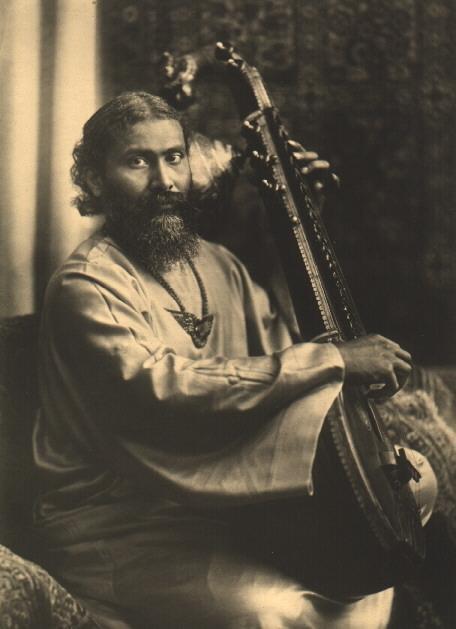
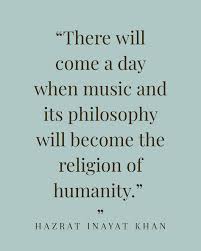
“The whole of life in all its aspects is one music, and to tune one’s self to the harmony of this perfect music is the real spiritual attainment.” – Hazrat Inayat Khan (b. July 5 1882)
In many traditions, music is not considered a human invention. Rather, humans discover music because the cosmos itself is already musical.
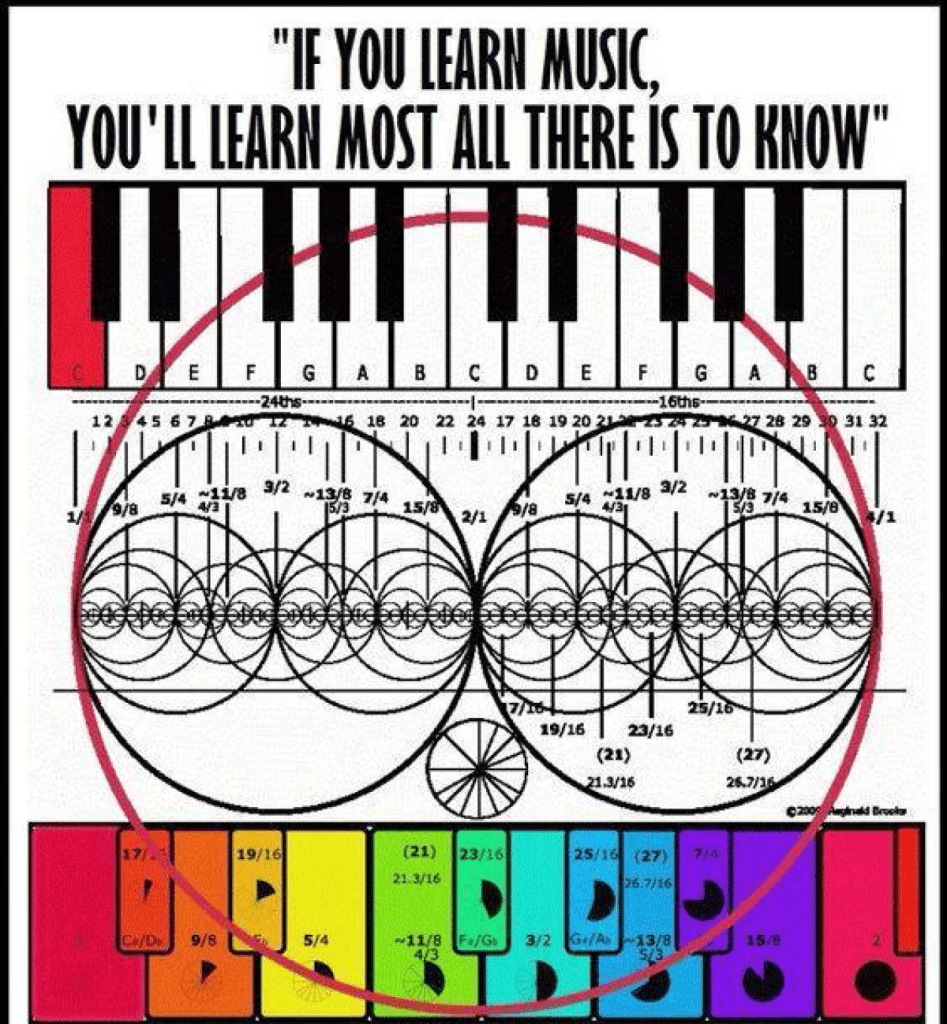
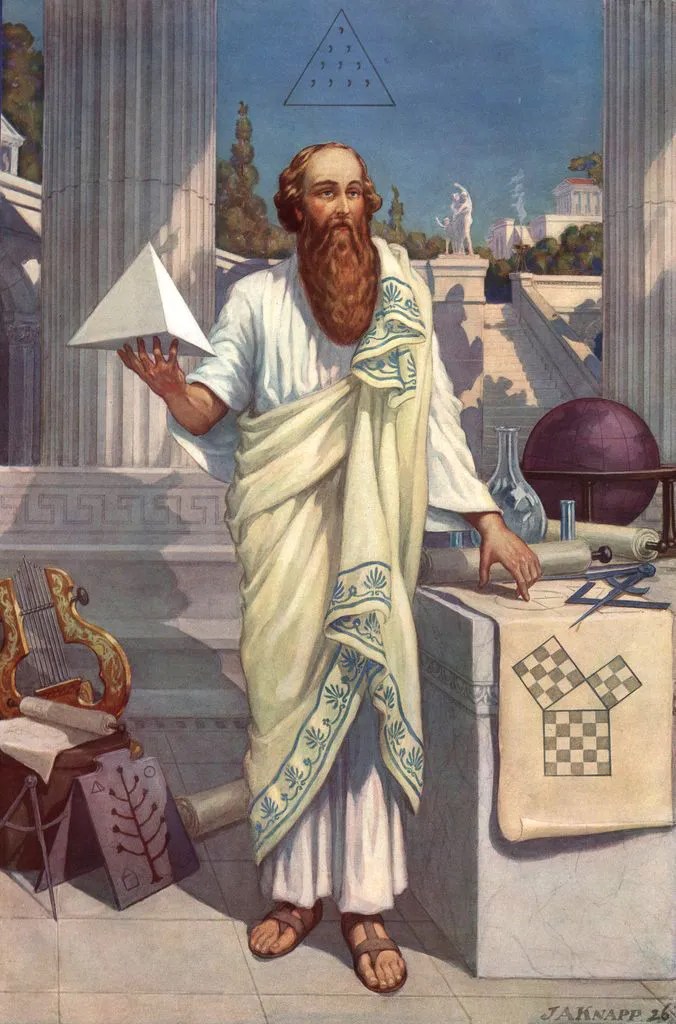
The Pythagoreans noticed that harmonious intervals correspond to simple mathematical ratios. From this they concluded that number, harmony, and cosmic order are inseparable. The stars, planets, and elements were thought to participate in an invisible symphony known as the Music of the Spheres.
In India, Nada Brahma arrives at a remarkably similar conclusion through a different route. Instead of saying reality is number, it says reality is vibration. Creation emerges from primordial sound, often symbolized by the sacred syllable Om.
In Chinese cosmology, musical tones correspond to seasons, directions, elements, and celestial movements. Harmony in music reflects harmony in nature.
Despite vast cultural differences, all three traditions point toward the same intuition:
Reality is not a collection of isolated objects. It is a living pattern of relationships, proportions, and resonances.
Music becomes the most direct metaphor for understanding existence itself.
Another universal theme is that music stands between the visible and invisible realms.
2. Music as the Bridge Between Worlds
Among Indigenous peoples worldwide, songs are often not “composed” but received.
In Australian Aboriginal traditions, Songlines are not merely stories but pathways through reality itself. The land exists because it was sung into being.
In Native American traditions, healing songs may be received through dreams or visions.
In Amazonian shamanism, icaros (traditional healing chants and medicine songs used by shamans) are believed to come from plant spirits.
In Sufism, sacred music awakens remembrance of God.
In all these traditions, music is understood as a bridge connecting ordinary consciousness with a deeper reality.
Music is revelation.
3. Music as Healing
The modern field of music therapy has ancient roots.
Pythagoreans prescribed specific modes to restore balance.
Ancient Egyptians used music in healing temples.
Indigenous healers employ chants and drums.
Hildegard of Bingen viewed music as medicine for the wounded soul.
Hazrat Inayat Khan taught that every illness is fundamentally a loss of harmony.
Even today, neuroscience confirms that music uniquely affects emotion, memory, movement, attention, and social bonding.
Across centuries, the underlying idea remains:
Suffering is a form of dissonance.
Healing is a return to harmony.
4. Music as Spiritual Ascent
Many traditions regard music as a ladder leading upward toward transcendence.
For Plato, beautiful music trained the soul toward truth.
For Neoplatonists, harmony reminded the soul of its divine origin.
For Sufis, music awakens longing for union with God.
For Christians such as Hildegard of Bingen, sacred song allowed humanity to participate in heavenly worship.
For practitioners of Nada Yoga, listening eventually reveals the Anahata Nada—the “unstruck sound” beyond physical hearing.
Music is therefore not merely expression.
It is transformation.
The listener becomes different through listening.
5. The Mystery of Silence
One of the most surprising discoveries appears in advanced mystical traditions.
Music ultimately points beyond itself.
Zen Buddhism teaches that the deepest music may be silence.
Christian contemplatives speak of the “silent word.”
Sufis describe the stillness beyond sound.
Nada Yoga says that external sound eventually leads to inner sound, which eventually dissolves into pure awareness.
At the summit of many mystical paths, sound and silence cease to be opposites.
Silence becomes the source from which all music emerges and to which all music returns.
Like the pause between breaths.
Like the stillness between notes.
6. Humanity as an Instrument
Many traditions ultimately arrive at a profoundly personal conclusion.
The universe is musical.
The soul is musical.
Human life itself is musical.
For the Pythagoreans, the virtuous person is internally harmonious.
For Confucius, character is cultivated like a musical instrument.
For Sufis, the heart becomes a reed flute through which God breathes.
For Christian mystics, the soul becomes a vessel for divine song.
For Inayat Khan:
The whole of life is music.
The goal is not merely to hear harmony.
The goal is to become harmonious.
7. A Possible Universal Philosophy of Music
If one were to synthesize all these traditions into a single worldview, it might look something like this:
The universe originates in a primordial harmony. Every star, atom, organism, and consciousness participates in that harmony in its own way. Human suffering arises when we experience ourselves as separate from the larger song. Through beauty, music, love, contemplation, service, and spiritual practice, we gradually remember our place within the symphony. Enlightenment, salvation, liberation, or wholeness is not escaping the music—it is learning to hear it clearly and to play our note well.
This is why the image of the “note in the symphony” is so powerful.
A single note alone can seem insignificant.
Yet without it, the symphony is incomplete.
Many of the world’s musical mystics—from the Pythagoreans to the Sufis, from Nada Yoga to Hildegard, from Aboriginal Songlines to Robert Fludd’s Temple of Music—would likely agree on one thing:
The deepest purpose of life is not to become the whole symphony. It is to discover the note you were meant to play, and to play it in harmony with the greater song.
Ancient and Classical Traditions
Pythagoreanism
Universe structured by numerical and musical ratios.
Music reflects cosmic order.
Source of the “Music of the Spheres” concept.
Platonism
Music shapes the soul.
Harmony reflects eternal forms.
Musical education cultivates virtue.
Neoplatonism
Music helps the soul ascend toward the One.
Cosmic harmony mirrors spiritual reality.
Orphism
Sacred songs and chants purify the soul.
The universe originates through divine song.
Hindu Traditions
Nada Brahma
“The universe is sound.”
Creation emerges from primordial vibration.
Anahata / Anhad Nada
The “unstruck sound.”
Inner mystical music heard in deep meditation.
Nada Yoga
Spiritual realization through sound and listening.
Raga Philosophy
Specific musical forms embody cosmic moods and forces.
Music aligns consciousness with nature and divinity.
Bhakti Traditions
Devotional singing as a direct path to God.
Kirtan and bhajan traditions.
Kashmir Shaivism
Reality unfolds through divine vibration (Spanda).
Buddhist Traditions
Tibetan Buddhism
Ritual instruments symbolize cosmic principles.
Chanting transforms consciousness.
Shingon Buddhism
Sacred sound and mantra as manifestations of enlightenment.
Zen Buddhism
Silence itself becomes musical.
Music expresses spontaneity and awakening.
Pure Land Buddhism
Chanting divine names as spiritual practice.
Chinese Traditions
Confucian Music Philosophy
Music creates social harmony and moral order.
Proper music cultivates virtue.
Daoism
Natural rhythms reflect the Dao.
Music emerges from harmony with nature.
Chinese Cosmology
Musical tones correspond to seasons, elements, and cosmic forces.
Japanese Traditions
Gagaku
Court music reflecting cosmic order.
Shinto
Sacred music invites divine presence.
Zen Arts
Flute, shakuhachi, and silence as spiritual practice.
Ancient Near Eastern Traditions
Mesopotamian Temple Music
Music connects humanity and gods.
Egyptian Sacred Music
Sound used in ritual and healing.
Music associated with divine creation.
Jewish Traditions
Biblical Temple Music
Music as worship and prophecy.
Kabbalah
Music restores cosmic harmony.
Divine creation linked with vibration and speech.
Hasidism
Sacred melodies (Nigunim) elevate consciousness.
Wordless song transcends language.
Christianity
Early Christian Chant
Music as prayer.
Gregorian Chant
Sacred sound reflecting heavenly order.
Eastern Orthodox Mysticism
Chant participates in celestial worship.
Hildegardian Theology
Creation itself sings divine praise.
Medieval Scholasticism
Music as one of the mathematical sciences.
Christian Neoplatonism
Harmony reflects divine order.
Quaker Spirituality
Inner silence as sacred music.
Islamic Traditions
Sufism
Music awakens remembrance of God.
Sama and whirling ceremonies.
Persian Mysticism
Music as intoxication with the Divine.
Turkish Mevlevi Tradition
Cosmic dance and sacred music.
Islamic Cosmology
Harmonic structure within creation.
Indigenous Traditions
Native American Traditions
Songs received from spirits.
Music as healing and prayer.
Australian Aboriginal Traditions
Songlines create and sustain reality.
African Spiritual Traditions
Drumming connects visible and invisible worlds.
Amazonian Traditions
Sacred healing songs (Icaros).
Arctic/Shamanic Traditions
Drumming enables spirit travel.
Western Esotericism
Hermeticism
Cosmos structured by harmonic correspondences.
Rosicrucianism
Music reveals hidden spiritual laws.
Alchemy
Harmony symbolizes transformation.
Christian Cabala
Musical correspondences among divine realms.
Freemasonry
Harmony as symbol of cosmic order.
Renaissance and Early Modern Thinkers
Marsilio Ficino
Music harmonizes soul and cosmos.
Robert Fludd
Universe as a divine monochord.
Temple of Music symbolism.
Johannes Kepler
Planetary motion as cosmic harmony.
Mathematical music of the heavens.
Modern Esoteric and Spiritual Movements
Anthroposophy
Rudolf Steiner taught music reveals spiritual realities.
Theosophy
Cosmic vibration underlying existence.
New Thought
Frequency and resonance as spiritual principles.
New Age Spirituality
Healing through sound and vibration.
Sound Healing
Conscious use of frequencies for healing.
Cymatics
Visible patterns produced by sound, often interpreted spiritually.
Mystical Musicians and Visionaries
Hildegard of Bingen
Celestial harmony.
Jalal al-Din Rumi
Music as longing for God.
Hazrat Inayat Khan
Entire universe as music.
George Gurdjieff
Sacred music awakens higher consciousness.
Karlheinz Stockhausen
Music as cosmic and spiritual communication.
Sun Ra
Music as a vehicle for cosmic consciousness.
If all these traditions were distilled into one idea, it might be:
Existence is fundamentally relational, rhythmic, and harmonic. Music is not merely something humans invented; it is one of the deepest ways reality reveals its structure. Through music, chanting, listening, silence, rhythm, and vibration, human beings can remember their connection to the cosmos, the Divine, one another, and themselves.
From a Scientific Perspective:
Resonance
One of the most important concepts in music is resonance: systems naturally vibrate at certain frequencies. Resonance is everywhere in physics:
Atoms have characteristic energy levels.
Molecules vibrate.
Bridges resonate.
Stars oscillate.
The Earth itself vibrates in measurable modes.
Electromagnetic fields behave as waves.
In this sense, nature is full of rhythmic and oscillatory behavior.
Harmonics
Musical notes contain harmonics—whole-number frequency relationships. Similar mathematical relationships appear throughout nature:
Vibrating strings.
Quantum systems.
Standing waves.
Orbital resonances among planets and moons.
For example, some moons of Jupiter orbit in simple ratios reminiscent of musical intervals.
Waves Everywhere
Modern physics describes much of reality through wave phenomena:
Light is a wave.
Quantum particles are described by wavefunctions.
Fields oscillate.
Gravitational waves ripple through spacetime.
The universe is not silent in a mathematical sense; it is full of oscillations.
Cosmic Background “Music”
Scientists have converted data from the early universe into audible frequencies.
The tiny fluctuations in the early cosmos that eventually formed galaxies can be represented as vibrations. Researchers sometimes describe these primordial oscillations as the “sound” of the early universe, although this is a metaphorical translation of physical data.
String Theory
One reason people often associate modern physics with music is the popular description of string theory.
In some versions of string theory, fundamental entities are tiny vibrating strings. Different vibrational modes correspond to different particles.
Many philosophers, mystics, and even some scientists have noticed that reality shares remarkable similarities with music, though whether the universe literally is music depends on how you define the term.
Music is fundamentally about relationships, patterns, rhythm, vibration, harmony, resonance, and change through time. Reality appears to exhibit many of these same qualities:
At the physical level, sound is vibration, and modern physics describes matter itself as oscillating fields and waves.
Planets move in repeating cycles, much like rhythms and meters.
Atomic structures and electromagnetic frequencies resemble harmonic relationships.
Biological life is rhythmic: heartbeats, breathing, sleep cycles, seasons, and circadian clocks.
Human societies move through recurring patterns of growth, decay, conflict, and renewal, almost like musical themes and variations.
Robert Fludd, in particular, saw the universe as a vast musical instrument. In his “Temple of Music,” the monochord symbolized the entire cosmos stretching between the divine and material worlds. Music was not merely entertainment but a map of reality itself.
Modern science would not say that stars are literally singing melodies or that galaxies are performing symphonies. However, it does describe reality in terms of frequencies, oscillations, resonance phenomena, wave interference, and mathematical patterns. Those concepts are surprisingly close to musical language.
In that sense, reality may behave much like music: countless individual parts woven together into a larger pattern whose full meaning can only be grasped by experiencing the whole…
The universe is not a machine made of separate objects. It is more like a symphony made of relationships, where every being is a note, every life a melody, and every moment part of a larger harmony unfolding through time.
Zoroastrianism
The House of Song is one of the most beautiful and poetic ideas in Zoroastrianism. It is called Garo Demana (also rendered Garodemana, Garotman, or “House of Hymns”), and it is traditionally understood as the highest heaven—the destination of souls who have lived according to truth, wisdom, and righteousness.
In classical Zoroastrian belief, after death the soul approaches the Chinvat Bridge, the “Bridge of Judgment.” There the soul’s thoughts, words, and deeds are weighed. If one’s life has been aligned with Asha—truth, order, and righteousness—the bridge widens and the soul is guided into the House of Song. If not, the soul falls into the House of Lies (Druj Demana).
What makes the House of Song so fascinating is that heaven is described musically. The righteous enter a realm of divine hymns, praise, light, and union with Ahura Mazda. Ancient texts describe it as the abode where songs of praise, prayers, and good deeds are gathered and preserved.
Some modern scholars and Zoroastrian interpreters go even further. They note that in the oldest hymns of Zarathustra, the House of Song may not refer only to a place after death but also to a state of consciousness—a condition of living in harmony with the Good Mind (Vohu Manah) and divine truth. In this reading, the House of Song is the soul’s alignment with cosmic order itself.
In a single sentence, the Zoroastrian House of Song could be summarized as:
Heaven is the soul’s return to perfect truth, perfect light, and perfect music.
From this perspective, music can be understood as a reflection of Asha—an audible expression of cosmic harmony.
Viewed through a musical lens:
Asha resembles harmony, consonance, and proper tuning.
Druj resembles disorder, distortion, and dissonance.
The spiritual task of humanity is to help restore cosmic harmony through right thought, right speech, and right action
How Zoroastrianism Fits Into the Larger “Music of the Universe” Tradition
If we compare the major traditions:
Tradition
Central Musical Idea
Pythagoreanism
Universe is mathematical harmony
Nada Brahma
Universe is divine sound
Sufism
Music awakens remembrance of God
Kabbalah
Sacred song restores creation
Hildegard
Creation sings divine praise
Fludd
Cosmos is a divine instrument
Steiner
Music reveals spiritual worlds
Zoroastrianism
Sacred sound aligns humanity with cosmic order (Asha)
So while Zoroastrianism is not usually classified as a “music philosophy” in the same way as Pythagoreanism or Nada Yoga, it contributes an important idea:
The universe is fundamentally ordered and harmonious, and sacred sound, chant, and prayer help human beings attune themselves to that divine order.
In a larger synthesis, Zoroastrianism serves as a bridge between the Indian idea of cosmic vibration and the Western idea of cosmic harmony. It emphasizes that spiritual music is not only about mystical experience, but also about ethical alignment—living in tune with the truth woven into the structure of creation.
John Coltrane
John Coltrane did not leave behind a formal philosophical system, but throughout his interviews, writings, and music, a clear spiritual philosophy emerges.
1. Music as a Path to God
After overcoming addiction in 1957, Coltrane described having a profound spiritual awakening. In the liner notes to A Love Supreme, he wrote that he had experienced “a spiritual awakening which was to lead me to a richer, fuller, more productive life.”
For Coltrane, music became a form of prayer and devotion. He saw artistic creation as a way of expressing gratitude to God and helping others experience something sacred.
A famous statement of his was:
“My goal is to live the truly religious life and express it in my music.”
For Coltrane, religion did not mean belonging to a single creed. It meant direct experience of the Divine.
2. Universal Spirituality
Coltrane studied many traditions:
Christianity
Hinduism
Buddhism
Islam
Kabbalah
Yoga
African spiritual traditions
Rather than choosing one exclusively, he believed all authentic spiritual paths pointed toward the same ultimate reality.
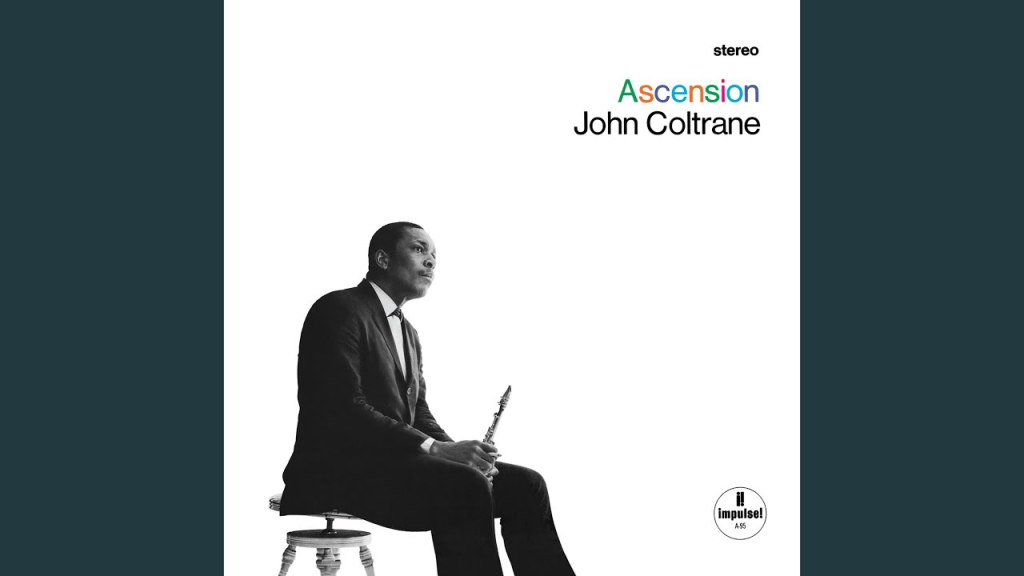
This universalism appears throughout his later work, including pieces such as Om, Meditations, and Ascension.
3. Music as a Vehicle for Transformation
Coltrane believed music could elevate consciousness.
He once said:
“I want to be a force for real good.”
He hoped music could heal, inspire, awaken, and transform listeners.
For him, the purpose of music was not merely entertainment. Music was capable of changing the inner state of the listener.
4. The Search for the Infinite
Many musicians seek mastery of an instrument.
Coltrane sought mastery as a means of approaching the infinite.
His famous “sheets of sound” style, relentless practicing, and constant experimentation reflected a spiritual quest rather than mere technical ambition.
He often spoke about searching:
searching for truth,
searching for God,
searching for deeper understanding.
The journey mattered more than arriving.
5. Sound as a Spiritual Force
Coltrane became increasingly interested in sound itself.
In his later music, notes are not merely melodies or harmonies. They become energy, vibration, and spiritual expression.
This is one reason many listeners compare his outlook to:
Nada Brahma
Sufi mysticism
Pythagorean harmony
Zen practice
mystical Christianity
His music increasingly moved toward pure sound as a vehicle for transcendence.
6. Love as the Highest Principle
The culmination of Coltrane’s philosophy may be found in A Love Supreme.
The title itself summarizes his worldview:
Reality is sacred.
God is present.
Gratitude is essential.
Love is the highest truth.
Everything else—technique, composition, improvisation, jazz itself—was secondary.
Robert Fludd believed that music was far more than an artistic activity or form of entertainment. To him, music was one of the fundamental principles through which God created and sustained the universe. Drawing upon ancient Pythagorean philosophy, Christian mysticism, Neoplatonism, and Hermetic thought, Fludd saw all of existence as ordered according to harmony, proportion, and number. The mathematical relationships that produce musical intervals were, in his view, the same relationships that govern the movements of the heavens, the structure of nature, and the life of the human soul. Music was therefore not merely something human beings invented; it was woven into the fabric of reality itself.
One of Fludd’s most famous symbols was the cosmic monochord, a one-stringed instrument representing the whole of creation. In his illustrations, God is depicted as the divine musician, tuning the monochord of the universe. The string stretches from the highest spiritual realms down to the material world, connecting angels, planets, elements, and earthly creatures in a single harmonious system. This image expresses Fludd’s conviction that creation itself is a musical instrument played by God. Every being, every force of nature, and every human soul participates in this grand cosmic harmony. Nothing exists in isolation; all things are notes within a universal symphony.
Central to Fludd’s philosophy was the idea that humanity is a microcosm of the larger universe. Just as the cosmos is governed by harmonious relationships, so too is the human being. The body, mind, and soul reflect the same principles found throughout creation. Because humans mirror the structure of the universe, music possesses the power to restore balance within us. Harmony in music can awaken harmony in the soul, bringing order to emotions, thoughts, and spiritual life. For Fludd, music was not only aesthetic but therapeutic and transformative.
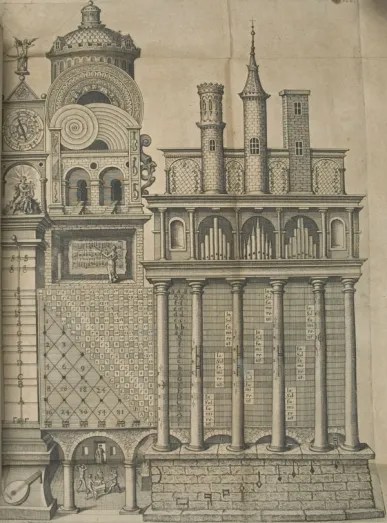
Fludd’s Temple of Music (pictured above) was not a real building but a symbolic diagram that represented his vision of the universe, music, and spiritual reality. It appeared in his monumental work, Utriusque Cosmi Historia (“History of the Two Worlds”), where he used elaborate engravings to illustrate the hidden relationships between God, humanity, nature, and harmony.
The Temple of Music portrays music as a sacred science that connects heaven and earth. Like a cathedral built according to divine proportions, the temple is structured around mathematical relationships corresponding to musical intervals. Every part of the image is meant to show that harmony is the underlying principle of creation. Music, geometry, mathematics, astronomy, and spirituality are presented not as separate disciplines but as different expressions of the same universal order.
Fludd also believed that music could serve as a pathway back to God. Beautiful and harmonious music reminds the soul of its divine origin and its place within the greater order of creation. Through contemplation of harmony, one can ascend spiritually, becoming more attuned to the wisdom and beauty underlying the visible world. Music thus becomes a bridge between heaven and earth, matter and spirit, humanity and the divine. In this sense, the musician is not merely an entertainer but a participant in a sacred mystery.
Underlying all of these ideas was Fludd’s belief that creation emerged from a primordial silence. Before the universe existed, there was an unmanifest divine reality beyond all form and distinction. From this hidden source arose vibration, harmony, and ultimately the created world itself. One might summarize Fludd’s vision as a movement from silence to sound, from sound to harmony, and from harmony to creation. The cosmos is therefore a living expression of divine music, continuously sustained by God’s ordering presence.
At the heart of Robert Fludd’s philosophy is the conviction that the universe is a sacred musical instrument, humanity is one of its notes, and the purpose of life is to become consciously attuned to the harmony that pervades all things. To live wisely is to listen for that deeper music beneath the noise of everyday life and to bring one’s own soul into resonance with the divine symphony of creation.
In early Mesopotamia, musical instruments were not simply tools for entertainment or artistic expression, they were imbued with profound spiritual significance and viewed as bridges between the human and the divine. The Sumerians, Akkadians, and later Babylonians regarded music as a sacred language that could communicate with gods, spirits, and celestial forces. Instruments such as the lyre, harp, drum, and flute were crafted with ritualistic care, often dedicated to particular deities or temple cults.
The lyre, perhaps the most emblematic of Mesopotamian instruments, was closely associated with the goddess Inanna (Ishtar), symbolizing heavenly harmony and divine presence. Mythological texts and archaeological evidence indicate that instruments were present in temple rituals, royal ceremonies, and funerary rites, where their sounds were believed to invoke divine favor, mediate prayers, and maintain the cosmic order. Musicians themselves held a priestly status, mediating the energies of the unseen through their performances.
The construction of these instruments often followed sacred proportions, and their materials; such as wood, gold, silver, and lapis lazuli, were chosen for symbolic resonance as well as acoustic quality. Inscriptions and iconography depict gods playing instruments or bestowing them upon humans, suggesting a cosmology in which music was both a divine gift and a vehicle for spiritual ascent. Thus, in early Mesopotamian consciousness, musical instruments embodied the divine, serving as conduits for the sacred and vehicles for the transformation of both individual and collective experience.
Music in ancient Egypt occupied a deeply spiritual and social role, woven intricately into religious, ceremonial, and everyday life. Egyptians viewed music as a divine creation, attributing its origins to their gods. The goddess Hathor, for instance, was revered as the patron of music, dance, and joy, symbolizing the nourishing and harmonizing power of sound. Bes, another deity, was associated with rhythm and protection, especially in domestic and birth rituals. Instruments themselves; such as the sistrum, harp, and lute, were imbued with sacred meaning, sometimes believed to channel protective and purifying energies.
Religious rituals heavily depended on music, which was believed to facilitate communication with the gods and the deceased. Temples employed specialized musicians and chantresses, often women, who performed hymns and chants to invite divine presence or appease powerful spirits. The act of music-making was seen as a way to uphold ma’at, or cosmic order, reinforcing the stability of both the natural world and human society. In funerary practices, music and song aided the soul’s transition to the afterlife, soothing fears and invoking blessings.
Beyond ritual, music permeated festivals, royal courts, and agricultural work, carrying the dual symbolism of joy and transcendence. Its rhythms and melodies were thought to balance emotions, heal disturbances, and foster communal harmony. Through these practices, ancient Egyptians demonstrated a belief that music could influence both visible and invisible realms, serving as a tool for transformation and a testament to the interconnectedness of all existence.
Maqams are the traditional melodic frameworks of Arabic, Turkish, Persian, and related musical traditions. While they are often compared to scales in Western music, a maqam is much more than a sequence of notes. Each maqam contains characteristic melodic patterns, emphasized tones, rules of movement, and a distinctive emotional or psychological atmosphere. Musicians learn not only which notes belong to a maqam but also how to unfold its unique character through improvisation and composition. Many maqams employ microtonal intervals—pitches that fall between the notes of a piano—which contribute to the subtle expressiveness and emotional depth for which these musical traditions are known.
The connection between maqam and mysticism is particularly strong within various Sufi traditions of the Islamic world. Mystics often regarded music as a means of awakening the heart and remembering humanity’s spiritual origin. In the practice known as Sama, music was listened to not merely for pleasure but as a form of contemplation capable of drawing the listener closer to divine reality. Different maqams were sometimes associated with different spiritual states, such as longing, devotion, humility, repentance, or inner balance. Rather than being viewed as entertainment alone, music became a vehicle for spiritual transformation and self-knowledge.
The instrument most closely associated with this mystical tradition is the Ney, whose breathy, plaintive sound became a symbol of the soul’s longing for reunion with the Divine. This symbolism is beautifully expressed in the writings of Jalal al-Din Rumi, who compared the human soul to a reed cut from its reed bed, forever yearning to return to its source. In this context, maqam music provides a sonic language through which feelings of separation, love, remembrance, and transcendence can be explored. A performer may move through several maqams during an improvisation, creating a musical journey that mirrors the soul’s passage through different stages of spiritual awakening.
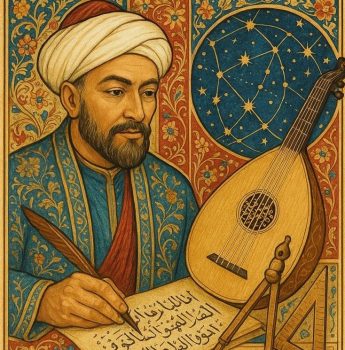
Historically, some philosophers and music theorists, such as Al-Farabi, believed that music reflected deeper cosmic and mathematical principles woven into the structure of the universe. This idea parallels other mystical traditions that view sound as a bridge between the visible and invisible worlds. In this sense, maqam music can be understood as more than an artistic practice; it is a contemplative art that seeks to reveal hidden dimensions of human experience. For many mystics, the purpose of maqam was not simply to create beautiful melodies but to use sound as a means of cultivating awareness, spiritual longing, and a deeper connection with the sacred.
In the Indian classical tradition, a raga is much more than a scale or a collection of notes. A raga is traditionally understood as a living melodic personality that evokes a particular emotional, psychological, and spiritual state. The Sanskrit word rāga comes from a root meaning “to color” or “to dye,” implying that a raga colors the mind and consciousness with a specific mood (rasa).
In many streams of Indian spirituality, especially within Hindu, yogic, and devotional traditions, ragas are viewed as pathways for transforming awareness. Each raga is associated with particular emotions, times of day, seasons, and sometimes even deities. The idea is that nature, the human psyche, and sound are interconnected. Performing or listening to the appropriate raga at the proper time helps align the individual with cosmic rhythms. Dawn ragas, for example, often evoke awakening, purity, and contemplation, while evening ragas may encourage surrender, longing, or devotion.
The spiritual foundation behind ragas is closely related to the concept of Nāda Brahma (“the universe is sound”). According to this view, creation itself arises from primordial vibration. Sound is not merely an artistic phenomenon but a manifestation of divine reality. A raga becomes a vehicle through which a musician and listener can move from ordinary consciousness toward a deeper experience of the sacred. Improvisation within a raga is therefore not merely creative expression but can become a form of meditation, prayer, or communion with the divine.
In the Bhakti traditions, ragas are often used to cultivate love and devotion toward God. Saints such as Mirabai and Tulsidas employed musical modes to express spiritual longing and ecstatic devotion. In these traditions, a raga can awaken feelings of yearning (viraha), love (prema), peace (shanti), or divine bliss (ananda), helping the devotee draw closer to the sacred.
From a yogic perspective, certain teachers have also associated ragas with subtle energies and the chakras, although these correspondences are generally later interpretations rather than part of classical raga theory itself. The underlying principle remains that sound has the power to influence consciousness, harmonize the mind, and facilitate inner awakening.
For someone interested in mysticism, the raga can be understood as a sonic “maqam” of the soul, a sacred landscape through which consciousness travels. Just as Sufi maqam describe stations on the spiritual path, a raga may be experienced as a particular spiritual atmosphere that invites the listener into a unique mode of being. The goal is not merely aesthetic enjoyment but a refinement of perception, leading toward stillness, insight, devotion, and ultimately a deeper awareness of the unity underlying all existence.
Anhad Nada (also called Anahata Nada) means the “unstruck sound”, a sound that is not produced by two objects striking together. It is considered by most Indian traditions to be an inner, eternal vibration that exists prior to ordinary physical sound. Mystics describe it as a subtle current of consciousness that can be perceived during deep meditation. Rather than being heard through the ears, it is said to be experienced inwardly through heightened awareness.
The relationship between Anhad Nada and Indian ragas is both philosophical and spiritual. A raga is not merely a scale or melodic pattern; traditionally it is viewed as a living sonic form capable of evoking specific moods (rasa), states of consciousness, and even spiritual realization. Many Indian musicians and mystics have regarded ragas as a bridge between audible sound (ahata nada, struck sound) and the deeper reality of Anhad Nada. In this view, the disciplined practice of a raga refines the listener’s and performer’s awareness, gradually leading from external music toward the perception of the inner cosmic music.
Classical Indian music is rooted in the broader concept of Nada Brahma, the idea that the universe itself is fundamentally vibration or sound. Within this framework, ragas become vehicles for tuning consciousness to subtler dimensions of being. Certain ragas, especially those associated with devotion, contemplation, or specific times of day, are traditionally believed to quiet the mind and open the practitioner to deeper spiritual perception. While a raga itself is not Anhad Nada, it can be understood as a symbolic reflection or manifestation of the same cosmic order from which the unstruck sound arises.
Many saints and mystics drew this connection. For example, Kabir frequently spoke of the “unstruck melody” (Anahad Shabd) heard within the heart. Guru Nanak and later Sikh Gurus also described the Anhad Shabad as a divine inner music perceived through spiritual practice. In these traditions, external sacred music, singing, and ragas are valuable because they help orient the mind toward that inner sound current. From a mystical perspective, the finest performance of a raga is not simply entertainment or artistic expression, it is an invitation to remember the deeper music that, according to these traditions, is always resonating within consciousness itself.
Philosophically speaking, a psalm is the voice of the human soul addressing the divine. It is a form of sacred poetry or song that arises from lived experience and is directed toward God, ultimate reality, or the sacred mystery at the heart of existence. A psalm can express joy, gratitude, awe, sorrow, repentance, doubt, longing, or trust. What distinguishes it is its personal and relational character: it is the soul speaking directly to the divine presence. In this sense, a psalm is a dialogue between the finite and the infinite, an attempt to give voice to the deepest movements of the human heart in the presence of what transcends it.
A hymn, by contrast, is primarily a song of praise and contemplation that celebrates the nature, beauty, power, or goodness of the divine. Rather than focusing on the individual’s struggles or experiences, a hymn turns attention toward what is considered worthy of reverence. It proclaims sacred truths, honors divine attributes, and seeks to elevate the mind and spirit toward a higher reality. While a psalm often speaks to God from the perspective of human experience, a hymn often speaks about God, creation, or the sacred order of the cosmos. It is less a conversation and more an act of admiration, wonder, and praise.
Viewed together, psalms and hymns represent two complementary dimensions of spiritual expression. The psalm begins with the human condition and reaches toward the divine; the hymn begins with the divine and invites human beings to participate in its beauty and harmony. The psalm is the soul’s response to life in all its complexity, while the hymn is the soul’s recognition of a transcendent reality worthy of praise. In a broader mystical sense, the psalm can be understood as the unique voice of an individual soul within the universe, whereas the hymn is a celebration of the greater harmony of which that soul is a part. The psalm is the personal note; the hymn is the song of the whole.
A kirtan is a form of sacred musical devotion in the traditions of Hinduism, especially within the Bhakti (devotional) movements. Philosophically, kirtan is more than a song or performance; it is a spiritual practice in which music, rhythm, and sacred words are used to cultivate direct participation in the divine presence. Typically performed in a call-and-response format, kirtan involves the communal chanting of the names, qualities, or stories of God. The goal is not artistic perfection or entertainment but the awakening of devotion, love, remembrance, and spiritual awareness.
Unlike a psalm, which is often a personal prayer addressed to God, or a hymn, which primarily praises the divine, kirtan emphasizes active engagement and communion. Through the repetition of sacred names and mantras, participants seek to transcend ordinary mental activity and enter a state of focused devotion. In the Bhakti tradition, the divine name is not considered merely a symbol of God but a living manifestation of the divine reality itself. Thus, chanting becomes a way of encountering and participating in that reality rather than simply speaking about it.
From a mystical perspective, kirtan is often understood as a form of Nada Yoga, the yoga of sacred sound. The vibrations of the chant are believed to harmonize the mind, emotions, and spirit, gradually drawing the practitioner toward a deeper experience of unity, love, and transcendence. The individual voice joins with the voices of others, creating a shared field of devotion in which personal concerns temporarily dissolve into a larger spiritual consciousness. In this sense, kirtan is not merely music about the divine, it is music as a vehicle for divine communion.
If a psalm is the soul speaking to God and a hymn is the soul praising God, then a kirtan is the soul seeking to merge with God through the transformative power of sacred sound. It is a musical path of remembrance, devotion, and participation in what many practitioners regard as the eternal music of the universe.
In the Middle Ages, music was studied alongside mathematics, geometry, and cosmology as part of the quadrivium. Music was believed to reflect hidden patterns and correspondences throughout the universe, linking numbers, the cosmos, nature, the soul, the human body, and moral life. Rather than treating concepts such as planetary harmony, sacred numbers, or the power of sound as mere metaphors, medieval thinkers saw them as parts of an interconnected reality. Speculative music asks “what if sound could reveal something deeper about existence?” Rather than focusing only on melody, harmony, or commercial form, speculative music often treats composition as a form of inquiry. The composer becomes less like a craftsman producing songs and more like an explorer mapping unseen realities through vibration, pattern, and symbolic structure.
Historically, speculative music has roots in very ancient ideas. In the school of Pythagoras, music was believed to reflect mathematical truths underlying the cosmos. The idea of the “music of the spheres” proposed that celestial bodies moved according to harmonic ratios, producing an inaudible cosmic music that structured reality itself. In medieval philosophy, music was divided into different levels: musica instrumentalis (audible music), musica humana (the harmony of body and soul), and musica mundana (the harmony of the universe). In this worldview, composing music was not simply artistic expression but participation in cosmic order. This ancient speculative tradition later influenced mystics, occultists, avant-garde composers, and experimental musicians who saw sound as a bridge between matter and spirit.
In modern times, speculative music appears in many forms. Some composers create system’s based music derived from mathematics, astronomy, sacred geometry, artificial intelligence, or chance operations. Others use sound to imagine futuristic civilizations, altered states of consciousness, or spiritual dimensions. Artists such as Sun Ra treated music as cosmic mythology, blending jazz, Afrofuturism, space philosophy, and ritual into a speculative vision of liberation and transcendence. Experimental composers like John Cage used indeterminacy and silence to challenge assumptions about reality and perception itself. In ambient, electronic, drone, and avant-garde traditions, speculative music often creates environments rather than songs, inviting listeners into altered psychological or metaphysical spaces.
Musical alchemy refers to the transformation that occurs through the compositional process, not only transformation of sound, but transformation of consciousness. In alchemical symbolism, base matter is refined into gold through stages of purification, dissolution, recombination, and illumination. Applied to music, this means raw emotional experience, intuition, memory, suffering, dreams, and unconscious material are gradually transmuted into organized sonic form. The composer acts almost like an alchemist working in a symbolic laboratory. Melodies, harmonies, rhythms, and textures become equivalents of alchemical substances being heated, dissolved, purified, and recombined until they reveal a deeper essence.
Many composers describe this process in deeply mystical terms. A musical idea may begin as chaos, vague feeling, or unconscious impulse. Through composition, the artist shapes this unformed material into structure and meaning. The process often mirrors psychological transformation: confusion becomes clarity, fragmentation becomes unity, tension resolves into harmony. In this sense, composing music can function as a spiritual discipline or psychological integration process. The piece itself becomes a record of inner transformation. This is why certain works of music feel “alive” or spiritually charged, listeners perceive not only technical organization, but the residue of an inner journey encoded into sound.
Alchemy in music can also refer to the mysterious emergence of something greater than the sum of its parts. Notes alone are inert symbols, yet when combined in certain ways they generate emotion, memory, atmosphere, transcendence, or even states resembling revelation. This transformation is difficult to fully explain rationally. Two compositions may use similar technical materials, yet one feels profoundly transformative while another feels empty. The alchemical perspective suggests that composition involves invisible qualities: intention, symbolic resonance, psychological depth, intuition, and energetic coherence. The composer is not merely arranging sounds but cultivating conditions under which transformation can occur.
In speculative and alchemical approaches alike, music is often understood as a vibrational language that interacts directly with consciousness. Rather than representing reality the way painting or literature might, music moves through time and sensation, affecting emotion and perception before thought intervenes. Because of this, many mystical and philosophical traditions have regarded music as uniquely capable of mediating between visible and invisible worlds. In traditions ranging from Hermeticism to Nada Brahma, sound is treated as foundational to existence itself. From this perspective, speculative music becomes an attempt to rediscover hidden architectures of reality through sound, while the alchemy of composition becomes the personal transformation required to bring those hidden structures into audible form.
The therapeutic use of music stretches back thousands of years, with records from Ancient Egypt, Greece, China, and indigenous cultures worldwide that reference the use of music and rhythmic sound in rituals, healing practices, and spiritual ceremonies. In these early contexts, music was not considered entertainment alone, but a conduit for accessing altered states, harmonizing the body and mind, and facilitating connection with the divine.
Ancient Greek philosophers such as Pythagoras and Plato wrote about the power of music to influence mood, moral character, and even physical wellbeing. Pythagoras, for example, explored the concept of “musical medicine” through the mathematical relationship of harmonics, believing that certain modes and rhythms could recalibrate the soul. Throughout the Middle Ages and Renaissance, music continued to be used in Christian liturgy and monastic settings for purposes of spiritual purification and psychological care.
Modern music therapy as a formal discipline emerged in the twentieth century, particularly in the aftermath of World Wars I and II. Musicians played for veterans suffering from what was then known as “shell shock” (now recognized as PTSD), and hospital staff observed significant psychological and physical improvements among patients. These observations inspired the development of structured training programs and research into the clinical applications of music. The first academic program in music therapy was founded in the United States at Michigan State University in 1944, and professional associations such as the American Music Therapy Association (AMTA) were established to set standards for practice and research.
Today, music therapy is a recognized health profession practiced globally, grounded in a combination of psychological theory, neuroscience, and ancient traditions. Practitioners use a range of techniques, including improvisation, songwriting, receptive listening, and movement, to address emotional, cognitive, physical, and spiritual needs. At its core, music therapy continues to draw upon the recognition that sound can shift consciousness, facilitate healing, and foster a more integrated sense of self, principles that have remained consistent despite the evolution of methods and frameworks.
Sound healing practitioners attest that vibrations interact with the body and psyche on fundamental levels, offering unique pathways to emotional release and psychological healing. Everything in the body responds to vibrational input. When sound enters the body, it is not only heard through the ears but also felt through tissue, bone, and water, which comprise most of our physical form. This somatic engagement is one reason why certain frequencies, tones, or rhythms can evoke deep shifts in emotional states and bodily sensations.
Sound also operates as a form of entrainment. When exposed to a consistent external rhythm or frequency, the brain and body tend to synchronize with it. This can help stabilize chaotic emotional states, bringing coherence to mental patterns or heart rhythms that may be dysregulated by trauma or chronic stress. For example, binaural beats or certain drumming patterns can induce brainwave states associated with calm, creativity, or even trance, providing access to altered states where insight and integration become possible.
Emotionally, sound bypasses verbal filtering and cognitive defenses, connecting directly with the limbic system, the brain’s emotional center. This means that sound can access traumatic memory or feeling where words fail. Therapies that use the voice, such as toning, humming, or chanting, empower individuals to resonate internally, often releasing tension and unfreezing emotional content stored in the body.
The communal experience of sound, whether in ritual, group chant, or shared music, invites a sense of safety and mirroring. Being witnessed in one’s emotional process within a supportive sound environment can accelerate healing, dissolving isolation and promoting a sense of belonging.
For some, the act of creating or improvising music becomes a form of spiritual surrender. This process can quiet the ego, engaging what some traditions call the “Witness” or deeper Self. In communities, shared musical experiences often generate a sense of interconnectedness, dissolving boundaries and nurturing compassion. The mystical teachings of Sufism, for example, hold music as a path toward divine union, using rhythm and melody to transcend separateness and awaken the heart.
Ultimately, music’s potential for inner healing and spiritual growth is not confined to one tradition or method. Its resonance with the body, psyche, and even collective consciousness offers a versatile and deeply personal pathway.
String theory and music share a deep structural analogy rooted in the concept of vibration. At its core, string theory states that the most fundamental constituents of reality are not point-like particles, but rather one-dimensional “strings” that vibrate at specific frequencies. These vibrations give rise to the different particles and forces we observe in the universe. In a parallel fashion, music is created by the vibration of strings (such as those of a violin or guitar), air columns, or membranes, with each frequency producing a particular pitch or tone.
The resonance between these two domains lies in their reliance on harmonics and the mathematics of oscillation. In both string theory and music, the modes of vibration—known as harmonics or harmonics series—determine the unique manifestations that emerge. In string theory, a string vibrating at one frequency may manifest as an electron, while another frequency could manifest as a photon or graviton. In music, the overtone series determines the richness and timbre of a note, allowing complex emotional expressions.
From a spiritual and esoteric standpoint, many mystical traditions hold that the universe itself is constructed from sound or vibration. The Indian Vedic concept of Nada Brahma (“the world is sound”) and the Ancient Greek Musica Universalis (“Music of the Spheres”) both echo this ontological primacy of sound. String theory’s suggestion that the universe is, at its most fundamental level, a symphony of vibrations aligns with these ancient intuitions, proposing that the cosmos is, in a sense, music made manifest in physical form.
This analogy bridges the rational and the transcendent, inviting contemplation of the universe as an interconnected whole, much like a musical composition, where each note or string has its role, yet all are needed to create harmony. It inspires a sense of participation in a larger order, where understanding yourself is akin to attuning to your unique vibration within the universal symphony.
 Music of the Spheres