1. Music as the Structure of Reality
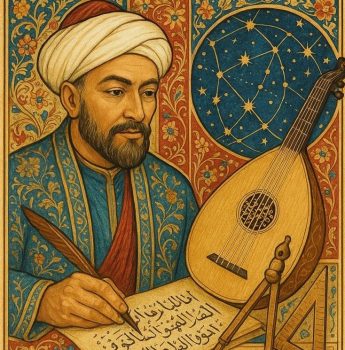
In many traditions, music is not considered a human invention. Rather, humans discover music because the cosmos itself is already musical.
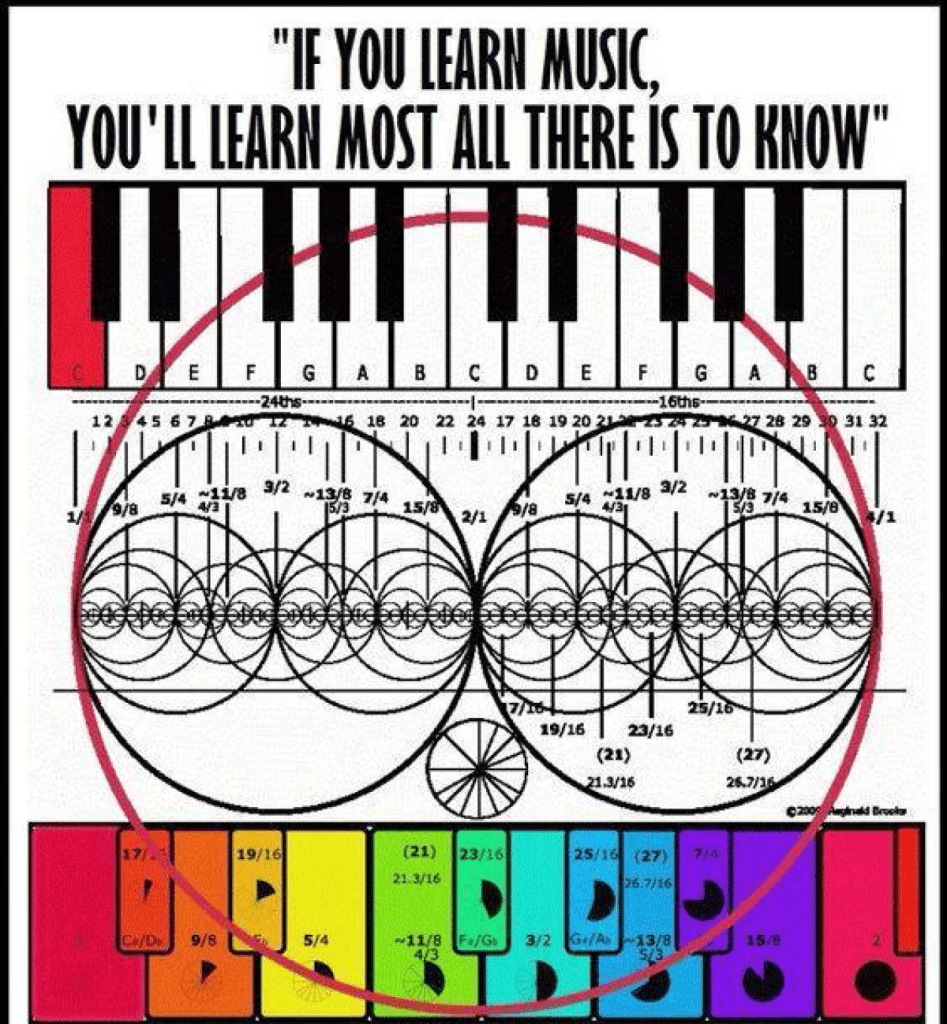
The Pythagoreans noticed that harmonious intervals correspond to simple mathematical ratios. From this they concluded that number, harmony, and cosmic order are inseparable. The stars, planets, and elements were thought to participate in an invisible symphony known as the Music of the Spheres.
In India, Nada Brahma arrives at a remarkably similar conclusion through a different route. Instead of saying reality is number, it says reality is vibration. Creation emerges from primordial sound, often symbolized by the sacred syllable Om.
In Chinese cosmology, musical tones correspond to seasons, directions, elements, and celestial movements. Harmony in music reflects harmony in nature.
Despite vast cultural differences, all three traditions point toward the same intuition:
Reality is not a collection of isolated objects. It is a living pattern of relationships, proportions, and resonances.
Music becomes the most direct metaphor for understanding existence itself.
Another universal theme is that music stands between the visible and invisible realms.
2. Music as the Bridge Between Worlds
Among Indigenous peoples worldwide, songs are often not “composed” but received.
In Australian Aboriginal traditions, Songlines are not merely stories but pathways through reality itself. The land exists because it was sung into being.
In Native American traditions, healing songs may be received through dreams or visions.
In Amazonian shamanism, icaros (traditional healing chants and medicine songs used by shamans) are believed to come from plant spirits.
In Sufism, sacred music awakens remembrance of God.
In all these traditions, music is understood as a bridge connecting ordinary consciousness with a deeper reality.
Music is revelation.
3. Music as Healing
The modern field of music therapy has ancient roots.
Pythagoreans prescribed specific modes to restore balance.
Ancient Egyptians used music in healing temples.
Indigenous healers employ chants and drums.
Hildegard of Bingen viewed music as medicine for the wounded soul.
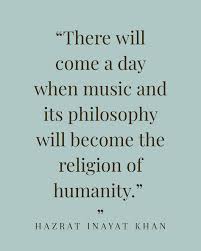
Hazrat Inayat Khan taught that every illness is fundamentally a loss of harmony.
Even today, neuroscience confirms that music uniquely affects emotion, memory, movement, attention, and social bonding.
Across centuries, the underlying idea remains:
Suffering is a form of dissonance.
Healing is a return to harmony.
4. Music as Spiritual Ascent
Many traditions regard music as a ladder leading upward toward transcendence.
For Plato, beautiful music trained the soul toward truth.
For Neoplatonists, harmony reminded the soul of its divine origin.
For Sufis, music awakens longing for union with God.
For Christians such as Hildegard of Bingen, sacred song allowed humanity to participate in heavenly worship.
For practitioners of Nada Yoga, listening eventually reveals the Anahata Nada—the “unstruck sound” beyond physical hearing.
Music is therefore not merely expression.
It is transformation.
The listener becomes different through listening.
5. The Mystery of Silence
One of the most surprising discoveries appears in advanced mystical traditions.
Music ultimately points beyond itself.
Zen Buddhism teaches that the deepest music may be silence.
Christian contemplatives speak of the “silent word.”
Sufis describe the stillness beyond sound.
Nada Yoga says that external sound eventually leads to inner sound, which eventually dissolves into pure awareness.
At the summit of many mystical paths, sound and silence cease to be opposites.
Silence becomes the source from which all music emerges and to which all music returns.
Like the pause between breaths.
Like the stillness between notes.
6. Humanity as an Instrument
Many traditions ultimately arrive at a profoundly personal conclusion.
The universe is musical.
The soul is musical.
Human life itself is musical.
For the Pythagoreans, the virtuous person is internally harmonious.
For Confucius, character is cultivated like a musical instrument.
For Sufis, the heart becomes a reed flute through which God breathes.
For Christian mystics, the soul becomes a vessel for divine song.
For Inayat Khan:
The whole of life is music.
The goal is not merely to hear harmony.
The goal is to become harmonious.
7. A Possible Universal Philosophy of Music
If one were to synthesize all these traditions into a single worldview, it might look something like this:
The universe originates in a primordial harmony. Every star, atom, organism, and consciousness participates in that harmony in its own way. Human suffering arises when we experience ourselves as separate from the larger song. Through beauty, music, love, contemplation, service, and spiritual practice, we gradually remember our place within the symphony. Enlightenment, salvation, liberation, or wholeness is not escaping the music—it is learning to hear it clearly and to play our note well.
This is why the image of the “note in the symphony” is so powerful.
A single note alone can seem insignificant.
Yet without it, the symphony is incomplete.
Many of the world’s musical mystics—from the Pythagoreans to the Sufis, from Nada Yoga to Hildegard, from Aboriginal Songlines to Robert Fludd’s Temple of Music—would likely agree on one thing:
The deepest purpose of life is not to become the whole symphony. It is to discover the note you were meant to play, and to play it in harmony with the greater song.
Ancient and Classical Traditions
Pythagoreanism
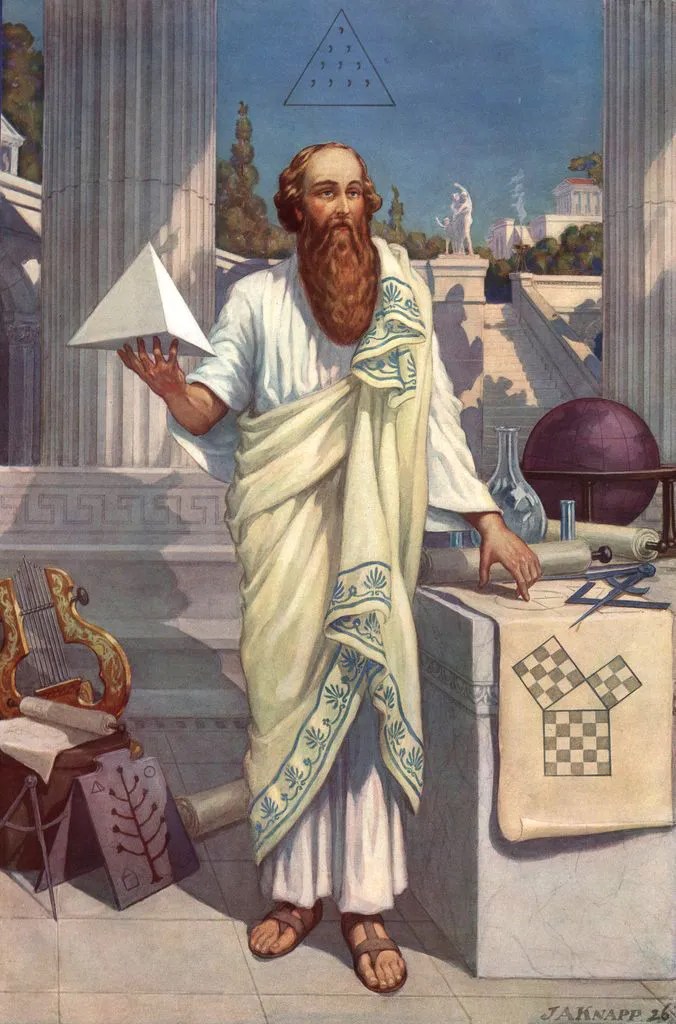
- Universe structured by numerical and musical ratios.
- Music reflects cosmic order.
- Source of the “Music of the Spheres” concept.
Platonism
- Music shapes the soul.
- Harmony reflects eternal forms.
- Musical education cultivates virtue.
Neoplatonism
- Music helps the soul ascend toward the One.
- Cosmic harmony mirrors spiritual reality.
Orphism
- Sacred songs and chants purify the soul.
- The universe originates through divine song.
Hindu Traditions
Nada Brahma
- “The universe is sound.”
- Creation emerges from primordial vibration.
Anahata / Anhad Nada
- The “unstruck sound.”
- Inner mystical music heard in deep meditation.
Nada Yoga
- Spiritual realization through sound and listening.
Raga Philosophy
- Specific musical forms embody cosmic moods and forces.
- Music aligns consciousness with nature and divinity.
Bhakti Traditions
- Devotional singing as a direct path to God.
- Kirtan and bhajan traditions.
Kashmir Shaivism
- Reality unfolds through divine vibration (Spanda).
Buddhist Traditions
Tibetan Buddhism
- Ritual instruments symbolize cosmic principles.
- Chanting transforms consciousness.
Shingon Buddhism
- Sacred sound and mantra as manifestations of enlightenment.
Zen Buddhism
- Silence itself becomes musical.
- Music expresses spontaneity and awakening.
Pure Land Buddhism
- Chanting divine names as spiritual practice.
Chinese Traditions
Confucian Music Philosophy
- Music creates social harmony and moral order.
- Proper music cultivates virtue.
Daoism
- Natural rhythms reflect the Dao.
- Music emerges from harmony with nature.
Chinese Cosmology
- Musical tones correspond to seasons, elements, and cosmic forces.
Japanese Traditions
Gagaku
- Court music reflecting cosmic order.
Shinto
- Sacred music invites divine presence.
Zen Arts
- Flute, shakuhachi, and silence as spiritual practice.
Ancient Near Eastern Traditions
Mesopotamian Temple Music
- Music connects humanity and gods.
Egyptian Sacred Music
- Sound used in ritual and healing.
- Music associated with divine creation.
Jewish Traditions
Biblical Temple Music
- Music as worship and prophecy.
Kabbalah
- Music restores cosmic harmony.
- Divine creation linked with vibration and speech.
Hasidism
- Sacred melodies (Nigunim) elevate consciousness.
- Wordless song transcends language.
Christianity
Early Christian Chant
- Music as prayer.
Gregorian Chant
- Sacred sound reflecting heavenly order.
Eastern Orthodox Mysticism
- Chant participates in celestial worship.
Hildegardian Theology
- Creation itself sings divine praise.
Medieval Scholasticism
- Music as one of the mathematical sciences.
Christian Neoplatonism
- Harmony reflects divine order.
Quaker Spirituality
- Inner silence as sacred music.
Islamic Traditions
Sufism
- Music awakens remembrance of God.
- Sama and whirling ceremonies.
Persian Mysticism
- Music as intoxication with the Divine.
Turkish Mevlevi Tradition
- Cosmic dance and sacred music.
Islamic Cosmology
- Harmonic structure within creation.
Indigenous Traditions
Native American Traditions
- Songs received from spirits.
- Music as healing and prayer.
Australian Aboriginal Traditions
- Songlines create and sustain reality.
African Spiritual Traditions
- Drumming connects visible and invisible worlds.
Amazonian Traditions
- Sacred healing songs (Icaros).
Arctic/Shamanic Traditions
- Drumming enables spirit travel.
Western Esotericism
Hermeticism
- Cosmos structured by harmonic correspondences.
Rosicrucianism
- Music reveals hidden spiritual laws.
Alchemy
- Harmony symbolizes transformation.
Christian Cabala
- Musical correspondences among divine realms.
Freemasonry
- Harmony as symbol of cosmic order.
Renaissance and Early Modern Thinkers
Marsilio Ficino
- Music harmonizes soul and cosmos.
Robert Fludd
- Universe as a divine monochord.
- Temple of Music symbolism.
Johannes Kepler
- Planetary motion as cosmic harmony.
- Mathematical music of the heavens.
Modern Esoteric and Spiritual Movements
Anthroposophy
- Rudolf Steiner taught music reveals spiritual realities.
Theosophy
- Cosmic vibration underlying existence.
New Thought
- Frequency and resonance as spiritual principles.
New Age Spirituality
- Healing through sound and vibration.
Sound Healing
- Conscious use of frequencies for healing.
Cymatics
- Visible patterns produced by sound, often interpreted spiritually.
Mystical Musicians and Visionaries
Hildegard of Bingen
- Celestial harmony.
Jalal al-Din Rumi
- Music as longing for God.
Hazrat Inayat Khan
- Entire universe as music.
George Gurdjieff
- Sacred music awakens higher consciousness.
Karlheinz Stockhausen
- Music as cosmic and spiritual communication.
Sun Ra
- Music as a vehicle for cosmic consciousness.
If all these traditions were distilled into one idea, it might be:
Existence is fundamentally relational, rhythmic, and harmonic. Music is not merely something humans invented; it is one of the deepest ways reality reveals its structure. Through music, chanting, listening, silence, rhythm, and vibration, human beings can remember their connection to the cosmos, the Divine, one another, and themselves.
From a Scientific Perspective:
Resonance
One of the most important concepts in music is resonance: systems naturally vibrate at certain frequencies. Resonance is everywhere in physics:
- Atoms have characteristic energy levels.
- Molecules vibrate.
- Bridges resonate.
- Stars oscillate.
- The Earth itself vibrates in measurable modes.
- Electromagnetic fields behave as waves.
In this sense, nature is full of rhythmic and oscillatory behavior.
Harmonics
Musical notes contain harmonics—whole-number frequency relationships. Similar mathematical relationships appear throughout nature:
- Vibrating strings.
- Quantum systems.
- Standing waves.
- Orbital resonances among planets and moons.
For example, some moons of Jupiter orbit in simple ratios reminiscent of musical intervals.
Waves Everywhere
Modern physics describes much of reality through wave phenomena:
- Light is a wave.
- Quantum particles are described by wavefunctions.
- Fields oscillate.
- Gravitational waves ripple through spacetime.
The universe is not silent in a mathematical sense; it is full of oscillations.
Cosmic Background “Music”
Scientists have converted data from the early universe into audible frequencies.
The tiny fluctuations in the early cosmos that eventually formed galaxies can be represented as vibrations. Researchers sometimes describe these primordial oscillations as the “sound” of the early universe, although this is a metaphorical translation of physical data.
String Theory
One reason people often associate modern physics with music is the popular description of string theory.
In some versions of string theory, fundamental entities are tiny vibrating strings. Different vibrational modes correspond to different particles.
Many philosophers, mystics, and even some scientists have noticed that reality shares remarkable similarities with music, though whether the universe literally is music depends on how you define the term.
Music is fundamentally about relationships, patterns, rhythm, vibration, harmony, resonance, and change through time. Reality appears to exhibit many of these same qualities:
- At the physical level, sound is vibration, and modern physics describes matter itself as oscillating fields and waves.
- Planets move in repeating cycles, much like rhythms and meters.
- Atomic structures and electromagnetic frequencies resemble harmonic relationships.
- Biological life is rhythmic: heartbeats, breathing, sleep cycles, seasons, and circadian clocks.
- Human societies move through recurring patterns of growth, decay, conflict, and renewal, almost like musical themes and variations.
Robert Fludd, in particular, saw the universe as a vast musical instrument. In his “Temple of Music,” the monochord symbolized the entire cosmos stretching between the divine and material worlds. Music was not merely entertainment but a map of reality itself.
Modern science would not say that stars are literally singing melodies or that galaxies are performing symphonies. However, it does describe reality in terms of frequencies, oscillations, resonance phenomena, wave interference, and mathematical patterns. Those concepts are surprisingly close to musical language.
In that sense, reality may behave much like music: countless individual parts woven together into a larger pattern whose full meaning can only be grasped by experiencing the whole…
The universe is not a machine made of separate objects. It is more like a symphony made of relationships, where every being is a note, every life a melody, and every moment part of a larger harmony unfolding through time.
Zoroastrianism
The House of Song is one of the most beautiful and poetic ideas in Zoroastrianism. It is called Garo Demana (also rendered Garodemana, Garotman, or “House of Hymns”), and it is traditionally understood as the highest heaven—the destination of souls who have lived according to truth, wisdom, and righteousness.
In classical Zoroastrian belief, after death the soul approaches the Chinvat Bridge, the “Bridge of Judgment.” There the soul’s thoughts, words, and deeds are weighed. If one’s life has been aligned with Asha—truth, order, and righteousness—the bridge widens and the soul is guided into the House of Song. If not, the soul falls into the House of Lies (Druj Demana).
What makes the House of Song so fascinating is that heaven is described musically. The righteous enter a realm of divine hymns, praise, light, and union with Ahura Mazda. Ancient texts describe it as the abode where songs of praise, prayers, and good deeds are gathered and preserved.
Some modern scholars and Zoroastrian interpreters go even further. They note that in the oldest hymns of Zarathustra, the House of Song may not refer only to a place after death but also to a state of consciousness—a condition of living in harmony with the Good Mind (Vohu Manah) and divine truth. In this reading, the House of Song is the soul’s alignment with cosmic order itself.
In a single sentence, the Zoroastrian House of Song could be summarized as:
Heaven is the soul’s return to perfect truth, perfect light, and perfect music.
From this perspective, music can be understood as a reflection of Asha—an audible expression of cosmic harmony.
Viewed through a musical lens:
- Asha resembles harmony, consonance, and proper tuning.
- Druj resembles disorder, distortion, and dissonance.
The spiritual task of humanity is to help restore cosmic harmony through right thought, right speech, and right action
How Zoroastrianism Fits Into the Larger “Music of the Universe” Tradition
If we compare the major traditions:
| Tradition | Central Musical Idea |
|---|---|
| Pythagoreanism | Universe is mathematical harmony |
| Nada Brahma | Universe is divine sound |
| Sufism | Music awakens remembrance of God |
| Kabbalah | Sacred song restores creation |
| Hildegard | Creation sings divine praise |
| Fludd | Cosmos is a divine instrument |
| Steiner | Music reveals spiritual worlds |
| Zoroastrianism | Sacred sound aligns humanity with cosmic order (Asha) |
So while Zoroastrianism is not usually classified as a “music philosophy” in the same way as Pythagoreanism or Nada Yoga, it contributes an important idea:
The universe is fundamentally ordered and harmonious, and sacred sound, chant, and prayer help human beings attune themselves to that divine order.
In a larger synthesis, Zoroastrianism serves as a bridge between the Indian idea of cosmic vibration and the Western idea of cosmic harmony. It emphasizes that spiritual music is not only about mystical experience, but also about ethical alignment—living in tune with the truth woven into the structure of creation.
John Coltrane
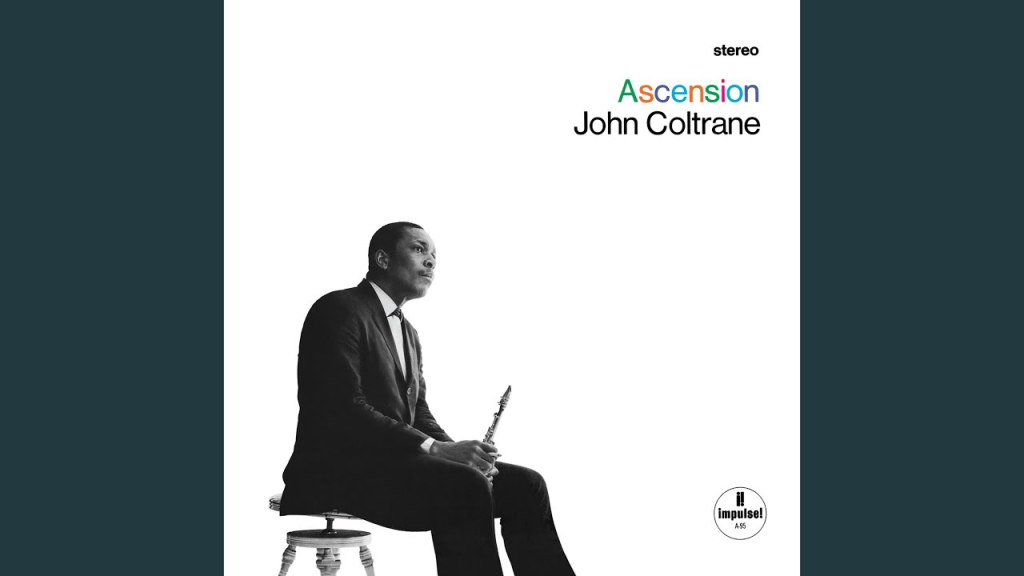
John Coltrane did not leave behind a formal philosophical system, but throughout his interviews, writings, and music, a clear spiritual philosophy emerges.
1. Music as a Path to God
After overcoming addiction in 1957, Coltrane described having a profound spiritual awakening. In the liner notes to A Love Supreme, he wrote that he had experienced “a spiritual awakening which was to lead me to a richer, fuller, more productive life.”
For Coltrane, music became a form of prayer and devotion. He saw artistic creation as a way of expressing gratitude to God and helping others experience something sacred.
A famous statement of his was:
“My goal is to live the truly religious life and express it in my music.”
For Coltrane, religion did not mean belonging to a single creed. It meant direct experience of the Divine.
2. Universal Spirituality
Coltrane studied many traditions:
- Christianity
- Hinduism
- Buddhism
- Islam
- Kabbalah
- Yoga
- African spiritual traditions
Rather than choosing one exclusively, he believed all authentic spiritual paths pointed toward the same ultimate reality.
This universalism appears throughout his later work, including pieces such as Om, Meditations, and Ascension.
3. Music as a Vehicle for Transformation
Coltrane believed music could elevate consciousness.
He once said:
“I want to be a force for real good.”
He hoped music could heal, inspire, awaken, and transform listeners.
For him, the purpose of music was not merely entertainment. Music was capable of changing the inner state of the listener.
4. The Search for the Infinite
Many musicians seek mastery of an instrument.
Coltrane sought mastery as a means of approaching the infinite.
His famous “sheets of sound” style, relentless practicing, and constant experimentation reflected a spiritual quest rather than mere technical ambition.
He often spoke about searching:
- searching for truth,
- searching for God,
- searching for deeper understanding.
The journey mattered more than arriving.
5. Sound as a Spiritual Force
Coltrane became increasingly interested in sound itself.
In his later music, notes are not merely melodies or harmonies. They become energy, vibration, and spiritual expression.
This is one reason many listeners compare his outlook to:
- Nada Brahma
- Sufi mysticism
- Pythagorean harmony
- Zen practice
- mystical Christianity
His music increasingly moved toward pure sound as a vehicle for transcendence.
6. Love as the Highest Principle
The culmination of Coltrane’s philosophy may be found in A Love Supreme.
The title itself summarizes his worldview:
- Reality is sacred.
- God is present.
- Gratitude is essential.
- Love is the highest truth.
Everything else—technique, composition, improvisation, jazz itself—was secondary.
Stay Attuned
 Music of the Spheres