Robert Fludd believed that music was far more than an artistic activity or form of entertainment. To him, music was one of the fundamental principles through which God created and sustained the universe. Drawing upon ancient Pythagorean philosophy, Christian mysticism, Neoplatonism, and Hermetic thought, Fludd saw all of existence as ordered according to harmony, proportion, and number. The mathematical relationships that produce musical intervals were, in his view, the same relationships that govern the movements of the heavens, the structure of nature, and the life of the human soul. Music was therefore not merely something human beings invented; it was woven into the fabric of reality itself.
One of Fludd’s most famous symbols was the cosmic monochord, a one-stringed instrument representing the whole of creation. In his illustrations, God is depicted as the divine musician, tuning the monochord of the universe. The string stretches from the highest spiritual realms down to the material world, connecting angels, planets, elements, and earthly creatures in a single harmonious system. This image expresses Fludd’s conviction that creation itself is a musical instrument played by God. Every being, every force of nature, and every human soul participates in this grand cosmic harmony. Nothing exists in isolation; all things are notes within a universal symphony.
Central to Fludd’s philosophy was the idea that humanity is a microcosm of the larger universe. Just as the cosmos is governed by harmonious relationships, so too is the human being. The body, mind, and soul reflect the same principles found throughout creation. Because humans mirror the structure of the universe, music possesses the power to restore balance within us. Harmony in music can awaken harmony in the soul, bringing order to emotions, thoughts, and spiritual life. For Fludd, music was not only aesthetic but therapeutic and transformative.
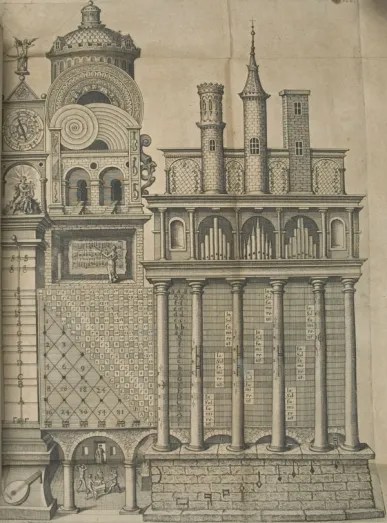
Fludd’s Temple of Music (pictured above) was not a real building but a symbolic diagram that represented his vision of the universe, music, and spiritual reality. It appeared in his monumental work, Utriusque Cosmi Historia (“History of the Two Worlds”), where he used elaborate engravings to illustrate the hidden relationships between God, humanity, nature, and harmony.
The Temple of Music portrays music as a sacred science that connects heaven and earth. Like a cathedral built according to divine proportions, the temple is structured around mathematical relationships corresponding to musical intervals. Every part of the image is meant to show that harmony is the underlying principle of creation. Music, geometry, mathematics, astronomy, and spirituality are presented not as separate disciplines but as different expressions of the same universal order.
Fludd also believed that music could serve as a pathway back to God. Beautiful and harmonious music reminds the soul of its divine origin and its place within the greater order of creation. Through contemplation of harmony, one can ascend spiritually, becoming more attuned to the wisdom and beauty underlying the visible world. Music thus becomes a bridge between heaven and earth, matter and spirit, humanity and the divine. In this sense, the musician is not merely an entertainer but a participant in a sacred mystery.
Underlying all of these ideas was Fludd’s belief that creation emerged from a primordial silence. Before the universe existed, there was an unmanifest divine reality beyond all form and distinction. From this hidden source arose vibration, harmony, and ultimately the created world itself. One might summarize Fludd’s vision as a movement from silence to sound, from sound to harmony, and from harmony to creation. The cosmos is therefore a living expression of divine music, continuously sustained by God’s ordering presence.
At the heart of Robert Fludd’s philosophy is the conviction that the universe is a sacred musical instrument, humanity is one of its notes, and the purpose of life is to become consciously attuned to the harmony that pervades all things. To live wisely is to listen for that deeper music beneath the noise of everyday life and to bring one’s own soul into resonance with the divine symphony of creation.
Stay Attuned

 Music of the Spheres